Security Tray, Border Desk: A Practical Guide to Travelling from the UK with CBD
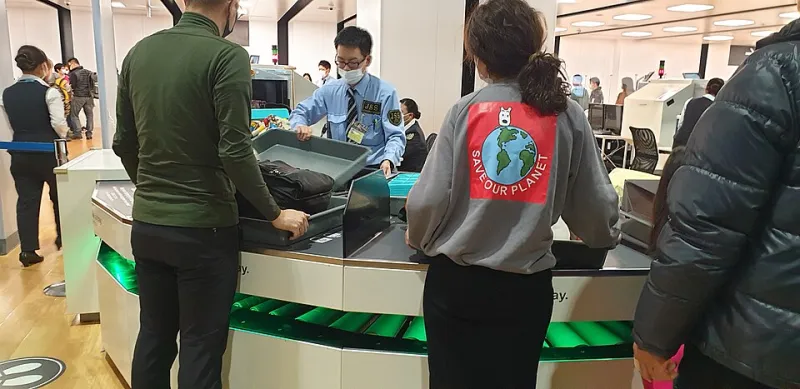
Photo: Jeena Paradies from Varberg, Schweden, CC BY 2.0, via Wikimedia Commons
Travelling with CBD is rarely difficult in the way people fear. It is difficult in the way people do not expect: not the security officer at Manchester, but the immigration official at a Gulf hub, or the customs officer in a country where cannabidiol is treated as a narcotic regardless of how the label reads. The two questions — will it get through the scanner, and will it get through the border — are entirely separate, and only one of them carries real consequences. What follows is general information rather than legal advice, and rules move; check official sources for your specific route before you travel.
First, work out what you are actually carrying
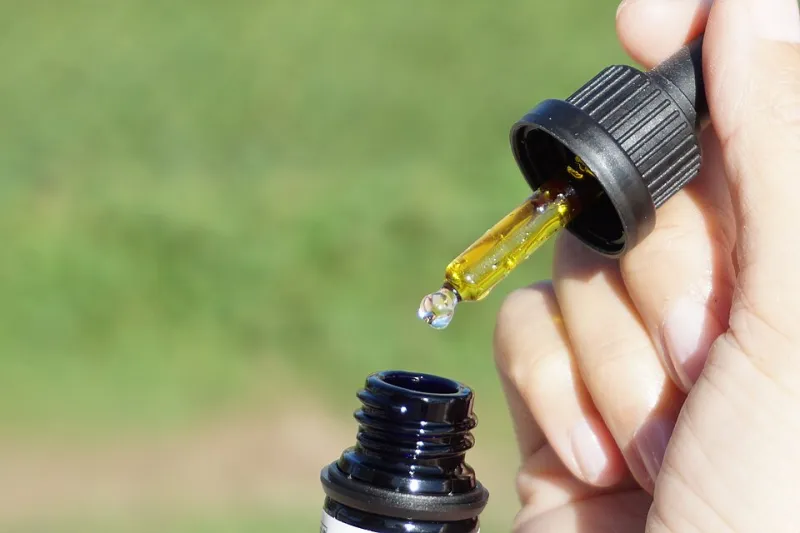
The security rules do not care what a product is for. They care what it is. Oils, tinctures and vape liquids are liquids. Balms, salves and creams are gels or spreads, and are treated the same way for screening purposes. Capsules are usually treated as solids, though softgel capsules can attract a second look. If your CBD comes as a cartridge for a vape device, the device itself may fall under separate battery and e-cigarette rules, which differ again by airline.
This matters because the phrase CBD oil encourages people to think of it as a health product rather than a toiletries item. At the security tray, it is the latter.
Security at UK airports in 2026
Many UK airports still require liquids in containers of 100ml or less, carried in a single clear resealable bag of about one litre, presented separately. Some airports and terminals have installed computed tomography scanners that allow larger containers and remove the need to unpack, but the rollout has been uneven and the rules genuinely differ from one site to another — and sometimes between terminals at the same site. The only reliable approach is to check your departure airport's own guidance in the week before you fly, rather than relying on a general article, including this one.
Whatever the local rule, three habits reduce friction. Keep products in their original retail packaging, with the label and batch number legible. Carry a batch-specific certificate of analysis, either printed or saved to your phone, showing cannabinoid content including THC. And do not decant into an unlabelled amber bottle to save weight. An anonymised liquid in a security tray is a conversation; a labelled one usually is not.
The domestic journey is the easy half
Flights within the UK, and ferries or trains between England, Scotland, Wales and Northern Ireland, raise few CBD-specific issues. Cannabidiol is lawful to possess and to buy for personal use, subject to novel food compliance on the seller's side. Security staff are looking for hazards and prohibited items, not cannabinoid profiles. If a product is queried, a brief factual answer plus the packaging normally closes the matter.
The complication arrives at the point of departure from the UK or arrival elsewhere, because a product's UK status has no purchase abroad.
Destination law is where the real risk sits
Some countries prohibit CBD outright, treating any cannabis-derived product as a controlled substance irrespective of THC content. The United Arab Emirates, Saudi Arabia and Singapore are the examples most often cited, and the penalties are serious. Others permit CBD but set their own THC ceilings, which may be lower than the UK's and may not recognise a UK certificate of analysis as proof of compliance. Within the European Union the picture is patchwork: some member states are comparatively permissive, others have tightened rules on hemp-derived products in recent years. In the United States, federal law permits hemp-derived products below a THC threshold, but individual states have moved in sharply different directions and the position has continued to shift through 2025 and into 2026 — a state-level check is essential rather than optional.
Transit is a border too
This is the mistake that catches experienced travellers. A connecting flight through a hub in a prohibition country brings your luggage, and arguably your person, under that country's law even if you never leave the terminal. If you are routing through Dubai or Doha with a full-spectrum oil in your wash bag, the fact that neither is your final destination is not a defence. Where a transit stop passes through a jurisdiction with strict rules, the simplest option is to leave the product at home and buy nothing until you are past it.
The paperwork that actually helps
No certificate makes a prohibited product permissible, so paperwork is a friction-reducer rather than a passport. What is worth carrying: the original packaging with the batch code; a certificate of analysis from that batch showing cannabinoid content; a copy of your purchase receipt; and, if you use CBD for a health reason under medical supervision, a brief letter from your GP or prescriber setting out what you take and why. Keep all of it together and easy to reach.
Prescribed cannabis-based medicines sit under a different regime entirely. Products such as Sativex and Epidyolex are controlled drugs in the UK, and travelling with them — particularly across borders — requires a letter from the prescriber, limits on the quantity carried, and in some circumstances a Home Office personal licence. That is a conversation to have with your specialist several weeks before departure, not at the airport.
Packing habits that keep things uneventful
Carry CBD in your hand luggage rather than checked baggage. You keep control of it, it stays at a stable temperature, and if a question arises you are present to answer it. Double-bag liquids against leaks, which are the most common cause of a ruined journey. Take a modest quantity consistent with personal use for the length of the trip; quantities that look commercial invite commercial questions. Never carry a product for a friend, however small the favour seems.
At the desk
If an officer asks about a product, answer directly and briefly. Concealment is far more damaging than disclosure, and a calm explanation of what the item is and why you have it is generally the end of the matter. If a product is seized, stay co-operative and ask for a record of what was taken. And accept, without resentment, the central asymmetry: a product that is entirely lawful on a British high street may be contraband three hours away by plane. Packing calmly begins with knowing which of those two situations you are flying into.